
Do you also collect stationery?

 Postal stationery? Such as postcards, change-of-address cards, and airmail sheets? Yes, postal stationery can also be collected. They are highly prized by collectors of special postmarks, because the impression can be reproduced very well on them. A stamp affixed to a card or envelope is always slightly raised above the paper on which it is affixed, and a postmark can then be interrupted. But you can also collect postal stationery for the items themselves. As an addition to a series of stamps that appeared simultaneously or in the same period, because they usually feature the same image as those stamps.


 As an example, three stamps from Germany just before 1900. In October 1889, a series of six stamps was issued: 3 Pf, 5 Pf, 10 Pf, 20 Pf, 25 Pf, and 50 Pf.
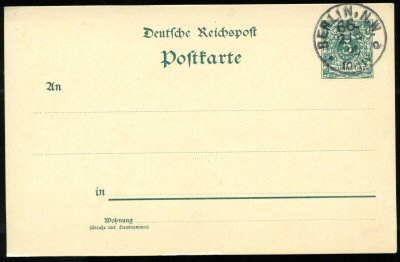
 A postcard with the same 5 Pf stamp impression was issued at the same time. The green color of both the stamp and the postcard indicated that it was intended for domestic use.
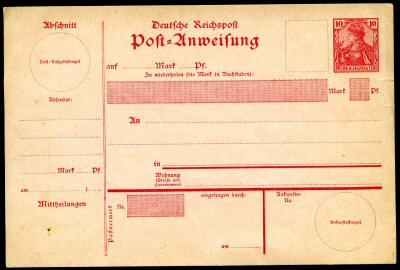 There was also a 10 Pf stamp in red for franking letters in domestic mail. However, a postcard with 10 Pf also appeared in red, intended for international mail. This was clearly indicated on the card by displaying the official French term: Carte postale en Union postale universelle.
 Then there is a 20 Pf stamp in blue for letters to foreign destinations. However, this stamp was also used on a money order form put into circulation in 1889. That 20 Pf was the rate for money orders at the time.
On May 2, 1895, a collector visited a post office in Berlin and purchased a set of postal items. He asked the clerk to properly stamp these items with the date stamp. However, the reply card attached to the double postcard was forgotten to be stamped. And the 10 Pf postal money order was also missing. This money order was issued in 1898 for amounts up to 5 Marks. This was clearly indicated once again on the reverse of the money orders issued in 1900. One can also expand a stamp collection in a fun and simple way with modern postal stationery. Any ideas?


Certainly a good idea. Furthermore, it is one of the 12 philatelic elements, allowing you to add some variety to your collection. I recently picked up a Geuzendam Catalogue from 1997, which lists all postal stationery from the Netherlands and Overseas Territories. It would be fun and educational to go through it. Does anyone know how often this catalogue is published?
'@Willem
PO&Po is working extremely hard to present the next version of the Geuzendam later this year.
What are those 12 elements, by the way? 🙂
'@Willem
Just the Po&Po website:
http://www.po-en-po.nl/
'@Cees
Nice idea to draw attention to the so-called UPU colors again!
Surely it should be possible with Dutch stamps and stationery as well?
Dear Cees,
Lately, I've been doing a bit of stamp hunting in the “area”.
A stamp on a piece of mail is the nicest, of course.
On the hunt for the new TNT stamp.
By now, I have encountered the most miraculous.
TNT employees have already confided in me that all stamps in the Netherlands are going to be replaced.
Due to a chemical reaction between the stamp ink and the glue holding the letters to the tilting mechanism, the stamp slides.
If you also want to collect some nice stamps, head out now.
The most beautiful omelets and pancakes are included now.
Good examples are: Overveen-Bloemendaalseweg and Haarlem-Santpoorterstraat.
Unfortunately, I am unable to attach the image here, so you are missing out!
Collecting Dutch postcards is great fun. There is a rich variety, and certainly still plenty at fairs, and with a bit of searching, available at reasonable prices. Personally, I still collect postcards; I have hung up my stamp collection.
If you want to see what a postcard collection looks like: come to the Postex in October, where two of my collections will be on display.
By the way, regarding the philatelic elements, you can take a look at the Association's website http://www.nbfv.nl , in the philatelic education section. By the way, what are your thoughts on the Association's website?
‘@Jan
You're obviously not waiting for compliments, are you? Or are you?
However, when I look at the section on the “12 philatelic elements,” it gives me the creeps. What era are we living in? It is high time to revise them, or at the very least tackle them fundamentally and structurally!
‘@Rein,
Of course not, unless from the then competent jury ……
Indeed, those album pages aren't exactly sophisticated. Perhaps Sjoerd Bangma will make a new set sometime. Incidentally, as part of the 100th anniversary of the NBFV, a collection from every category has been selected for closer inspection. The information offensive will likely begin soon. Keep an eye on the NBFV website!!
‘@Jan
I'm not even talking about how the 12 were worked out; I'm talking about how anyone got it into their heads to arrive at these 12 elements! Let Sjoerd think about that for a moment….
A number of philately experts have thought thoroughly about that 😉
These 12 Elements stem from the education of the youth (mid-90s, last century).
These 12 elements are guidelines. There are more than 12 elements in philately. It is simply a guideline to help the beginning—note this: beginning collector—get started.
And when it comes to collecting, “nothing is mandatory, everything is allowed.” Mind you, when it comes to collecting; exhibiting is something else entirely.
Yes, they are also in those ABC books...
‘@Albert
(mid-90s, last century)
So I should just be glad that it doesn't come from the 90s [1890!]
Maybe still acceptable for young people, but I have my doubts about that too...
‘@Albert
And when it comes to collecting, “nothing is mandatory, everything is allowed.” Mind you, when it comes to collecting; exhibiting is something else entirely.
Why????? As long as it fits within the exhibition framework, surely there's no problem?
and a lot fits in those new “round” frames! (even literally ;-))
For young people, it is indeed quite nice to work with the 12 elements. At the very least, they gain insight into the fact that there is something else “for sale” in philately besides the stamp. The 12 elements are, however, due for revision or expansion, such as:
element 13: backdoor issues
element 14: gadgets
element 15: barcode blasters
element 16: canons
And we could go on like this for a while, couldn't we, Rein?
'@Willem
No Willem!!!! We don't need 100 of them, and certainly not a complete overview of all philatelic entries in an encyclopedia, but we do need a systematic classification of main areas; it is the systematic approach that is currently missing – it is simply a list that hangs together like loose sand!
Rein,
At the time, I was also involved in compiling 12 (not THE 12) philatelic elements that the young collector could look out for when putting together a collection. We had lined up more than 40 (!) elements back then, and we deliberately omitted any structure. We looked at the most common (and recognizable) elements, as well as a few very special ones.
Can you make a suggestion that you think appeals more to the young collector than the current selection of 12?
'@Cees
Dear Cees, I am quite willing to accept that challenge, if only because what you wrote about it being for the youth and not 'THE 12' is incorrect.
From the course “Guidance in Philately” [surely not specifically for young people?]
• In the first part, the 12 most important elements of philately are discussed, providing a general insight into the subject matter.
• The second part consists of an exercise program. A part of the
The student's collection is provided by him/her with as much as possible
possibly parts from the first part and housed in a mini-
collection.
• In the third part, all elementary concepts from the first part are reviewed once again, but in much greater detail. This creates a
A well-organized reference work that will always remain at the service of the student.
In this course, 12 elements are covered, which, however, does not mean that there are no more to be found.
The last line leaves the door open a little, but that's about it 😉
Dear Rein, it was Jeugdfilatelie Nederland that took the initiative to create a brief overview of a number of 'philatelic elements'. The fact that this list was embraced by the 'seniors' proves, in my opinion, that it met a need (so not just among the youth). It was not the intention to destine this list for the advanced collector. Perhaps it would be advisable to compile twelve elements specifically for advanced collectors (we didn't choose 10, no Ten Commandments)? In any case, at the time we created a kind of 'guide' that benefited the youthful collector. So the challenge remains valid, even though you may translate that to the group of 'adults'. I am curious!
Gents,
I think that those 12 fairly randomly chosen elements actually make quite an important contribution to many collectors taking the “next step”: leaving the Davo box-filling behind. As such, the elements contribute to the further development of philately. Are the 12 elements a panacea? Of course not, but they do help.
I think that Rein makes collecting look a bit ridiculous.
God, that man can be so negative about our hobby; the worst part is that it concerns his own hobby.
We are not all interested in grids on the left or dots on the right. A stamp is a stamp.
In the same way, I can blame people for buying or exchanging a stamp just to look at the back, as if that side is nicer than the front.
A stamp must be used for its intended purpose, to frank mail. Then it can be collected, whether or not on a postal item, provided it is neatly cancelled.
Rein, at least leave your terrible negative stories out of this blog and do more advertising for our beautiful hobby.
Here is an alternative to your 12 elements: 1) Grid on the left
2) grid right
3) grid down
4) grid upwards etc. etc.
The fun of the philately hobby is its versatility: some collect thematically, others postal stationery, Rein grids, and dots.
Let's stop constantly making each other's lives miserable, and be happy that so many people still enjoy their hobby.
You are right
‘@Albert
Why so terribly negative?
Of my 9 postings on this subject, 1 is decidedly critical/negative and 1 is decidedly enthusiastic [Cees, UPU]; the rest are moderately neutral… Although, I was looking forward to the arrival of the new Geuzendam 🙂
I am quite critical of the 12 commandments – agreed – but at the same time I accept the challenge to come up with an alternative. So what is the problem, Albert?
‘@Rein,
Long time no see, do the cigars still taste good? I have seen the first texts for the new Geuzendam; the layout is being changed considerably. The numbering is being completely overhauled, entirely in accordance with the most recent insights and research. In particular, the numbering of the Dutch postcards is being adjusted. For example: the first form with the value impression added later will receive its own main number, just like the blue foreign card with a brown border. These cards have the same status. For those for whom all this is gibberish: come to the Postex in October. Further details at http://www.postex.info
‘@Jan
Are you from my father's generation? He was a die-hard cigar smoker! I've never smoked, at most I smoked along with him 😉
It is actually quite a shame that collecting postal stationery (postcards) is no longer as popular. This is a very attractive collecting area; postcards tell quite a story. In the past (19th century, early 20th century), postcards were used extensively, including for business correspondence. Roughly comparable to email today. There have been times when as many as 12 different, “normally usable” postcards were available at the counters, for example around 1915:
local maps (with and without divider) (1,5 cents)
local maps with paid answer (again in 2 variants)
domestic maps (2,5 cents, 2 variants)
Domestic maps with paid answer (2 variants) and international maps, again with and without dividing line and with paid answer.
If you also take into account that the cards changed quite often due to recommendations from the Universal Postal Union and comments from the “public”, then the variety of cards is easily explained.
We also have the so-called “private” postcards: a story in themselves. If I get voice on the blog, I would be more than happy to dedicate a piece to that as well …….
Is your father's name Rein too, then?
‘@Jan
We have been called “Reinier Cornelis” for 3 generations – in a sense, already 4 generations [The first RC lived from 1810-1865, was once engaged to Truitje Toussaint, worked with EJ Potgieter et al. for De Gids]; his son was named Charles René and went to the Indies after dad's death, lived with Conrad Busken Huet for some time; CR's son was another RC and worked, among other places, at the Botanic Garden in Buitenzorg; his son [my father] was also an RC [filius] and the undersigned then the 4th RC [filius2]. Apart from a few discoveries [Galeopsis pubescens in Asselt], I didn't make a career in botany 😉
‘@Jan
Postcards remained an excellent means of correspondence for a long time. In the period around 1966, contact between me and Jan Dekker was almost exclusively via postcards!
In the past, people could still write in reasonably legible handwriting. The correspondence between the various BvdB generations in the Netherlands East Indies in the period 1920-1940 is easy to follow and is all handwritten. It was only after 1945 that laziness started to set in; typewriter script and countless carbon copies that are now barely decipherable. 😉
‘@Rein,
Hey, did you keep all those postcards? Do you still collect postcards yourself?
Jn
‘@Jan
I'm the hoarding type; my wife complains like a queen 😉
Of course, I also collected postcards…. With a mentor like that, you couldn't get out of it. Thanks to Jan D., that printing technique obsession of mine really developed. Even with the Juliana and Profil BV postcards, the halftones are extremely important for cataloging!
Oh dear, I have to be careful what I write so as not to step on dear Albert's toes 🙂
‘@Rein,
You can always kick your wife out the door to make a bit more room 😉
Have you published anything about the grids on the Juliana in profile postcards? Seems quite interesting to me...
‘@Jan
Once in a draft text for the Handbook of the Netherlands….
Do you happen to still have that piece?
‘@Jan
HPN is a piece of the past that hasn't been processed 😉
In my view [or ideology, if you will], philately consists of 3 components:
– thematically
– post-historical and
– printing technology
All three are equally important to me and can also occur in combination; however, in practice—my time is limited—I will mainly focus on the printing technique.
If you are going to delve into such a subject, you must do it properly and make use of the realistic possibilities available to you. In printing technology, it is about simple tools: good eyesight, a loupe, a ruler, a UV lamp, some common sense, and background information on the technique itself.
When I see how little use is made of all this when studying 19th-century first emissions, or see, for example, how many different shades of blue are distinguished in these series, I find it hard to accept that a more thorough approach to more recent emissions is ridiculed or completely ignored.
Identifying, for example, all the plate errors in a first emission is just as philatelic as finding all the cylinder characteristics on a Beatrix 67c hanging block.
Fundamental research on more modern material is systematically ignored and/or ridiculed within organized philately, whether this applies to the stamp trade [with the NVPH catalogue], the association [with an exhibition assessment], or an HPN [with a full emphasis on the design and policy-technical aspects of the creation of stamps].
Perhaps this explains my “venom” a little when I “smell” hints of conservative philately…
'@Rein, (and @Cees)
Everything within philately is worth studying, so certainly also what you call “fundamental research” into modern stuff.
By the way, I must get this off my chest: I sometimes find the exhibition regulations (of the FIP, that is) a bit ridiculously rigid. I have been “rewarded” a few times with point deductions because I had included too many postal-historical features in a collection of stationery. And let’s be honest, when showing postcards, it is sometimes quite enlightening to say something about the cancellations—very educational—but… postal history. I believe that is accepted much more readily in a standard classical collection. Perhaps a reader of the blog with a jury background could respond to this? Cees, you do act as a judge sometimes, don’t you?
oops: rewarded
‘@Jan
You make typos much more easily here than in “normal” correspondence.
I was talking about “boetbal” the other day, but luckily you don't type in “beboond” yet…
of “babooned” 😉
‘@Jan
Did you know my father??? Through the Herbarium?
‘@Rein,
I don't think so, I'm a chemist, I don't know much about flora & fauna 😉
‘@Jan
And what about the cigars?
For some reason I thought you smoked cigars.....
HELLO,
PLEASE READ!
I found a postcard of the Netherlands for 0,55 ct.
Not strange in itself, except that the image of Beatrix isn't on it!
Who has more knowledge of or interest in this?
Who could tell me a bit more about this?
You can call 06-41492580
THANK YOU IN ADVANCE!
Matthieu, the card has been reported before: In the catalogue of auction 170 (Nov. 2002) of the Overijsselse Postzegelveiling BV, postcard G306 without the Beatrix head (unfortunately without further type designation) and a postcard G 306c without the ultramarine print are offered and depicted (so exclusively the Beatrix head and phosphor bar). Misprints therefore occur.
hello,
Thanks for the response!
Is there also any idea what the value of such a card is?
This one does have the phosphor bar, by the way.
No, I have no idea about the auction proceeds, but that can of course be checked with the relevant auctioneer. The phosphor bar is a separate print run in the postcard printing process, so it is separate from the image of the stamp impression.
First of all, compliments on the site..
My question concerns postcards from the PTT..
I recently bought some vending machines,
including postage stamps, postcards, and money exchange machines.
Now I want to refurbish them and equip them with
stamps and postcards.
The machines are from '63, I think..
Do you know which postcards were in this machine,
And are they still available in their original condition?
And were they changed often, annually for example?
And which stamp booklets were used?
I have 2 stamp vending machines, and one of them used stamp booklets, and the other a stamp roll?
Are those still available?